Emergency Savings & Income-Loss Resilience Report
Federal Reserve household evidence plus transparent cash-runway scenarios showing why “three months of savings” is a time target, not one universal dollar amount.
What $10,000 actually covers depends on the monthly cash shortfall
A reserve does not have one fixed “months” value. If some dependable income continues, the reserve only needs to cover the gap between essential outflows and remaining income. With a $10,000 accessible reserve, a $1,500 monthly shortfall lasts about 6.7 months; a $5,000 shortfall lasts only 2 months.
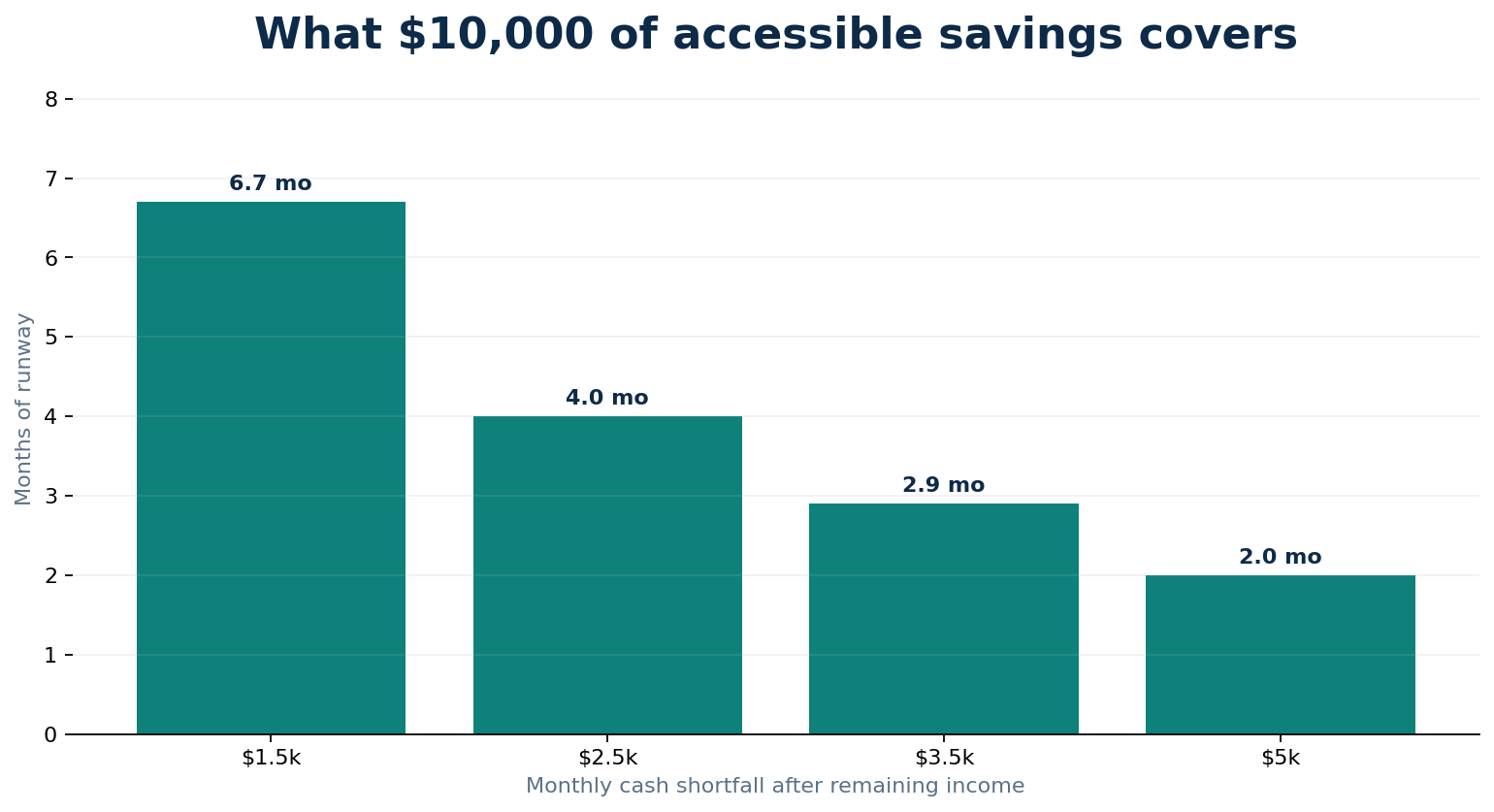
| Accessible reserve | $1,500 shortfall | $2,500 | $3,500 | $5,000 |
|---|---|---|---|---|
| $5,000 | 3.3 mo | 2.0 mo | 1.4 mo | 1.0 mo |
| $10,000 | 6.7 mo | 4.0 mo | 2.9 mo | 2.0 mo |
| $20,000 | 13.3 mo | 8.0 mo | 5.7 mo | 4.0 mo |
| $30,000 | 20.0 mo | 12.0 mo | 8.6 mo | 6.0 mo |
Federal Reserve evidence: Monthly budget margin and emergency savings move together
SHED does not say that monthly surplus automatically causes a larger emergency fund, but the association is stark. Only 13% of adults who said they never had money left over at month-end reported three months of savings, compared with 86% of those who always had money left over.
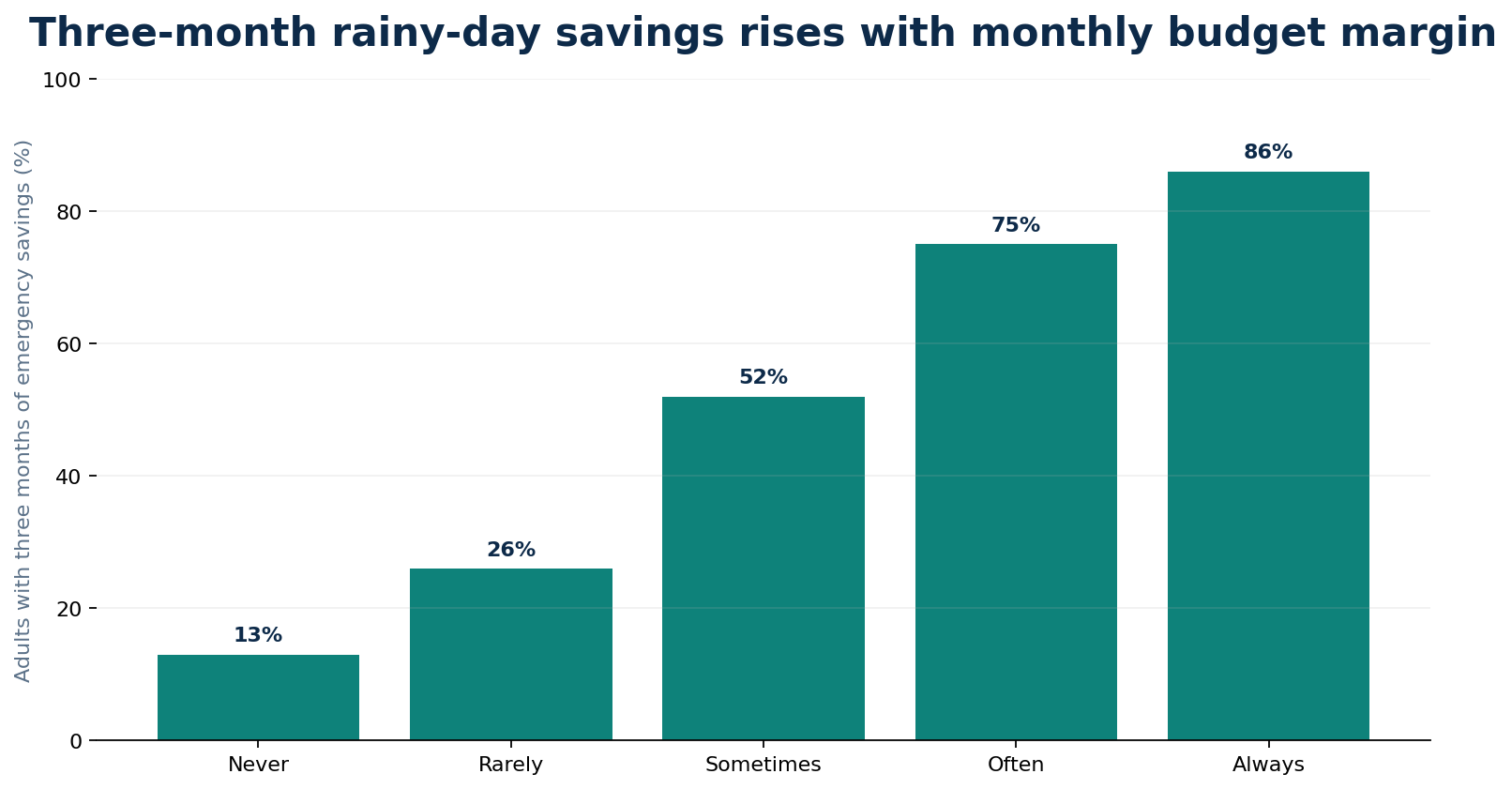
| How often money is left over | Have 3 months of savings |
|---|---|
| Never | 13% |
| Rarely | 26% |
| Sometimes | 52% |
| Often | 75% |
| Always | 86% |
How large an emergency expense could savings handle?
The 2025 SHED asked adults for the largest emergency expense they could handle using only savings. Thirty-eight percent selected $5,000 or more, while 30% selected less than $500.
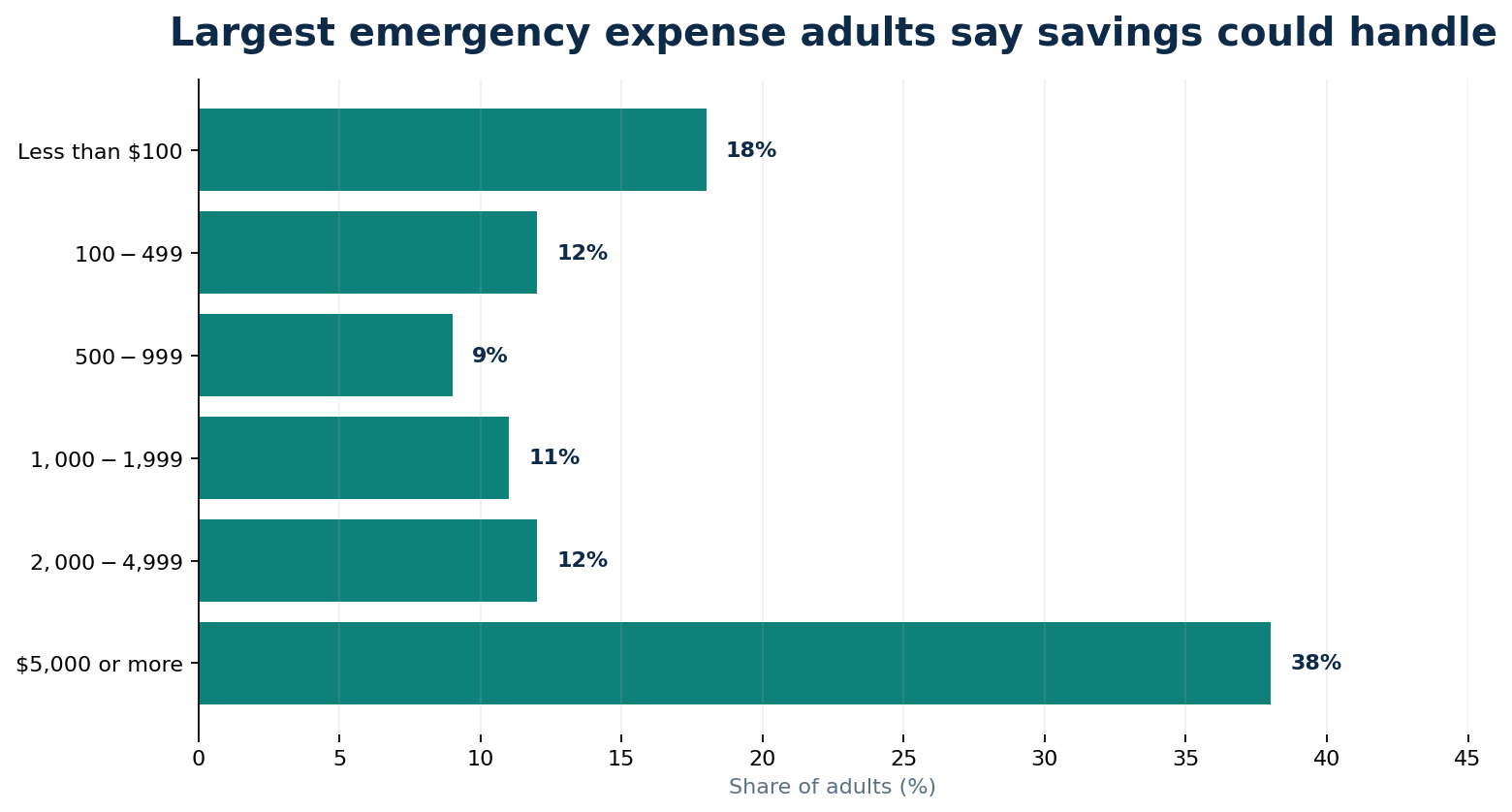
| Largest expense using only savings | Adults |
|---|---|
| Less than $100 | 18% |
| $100-$499 | 12% |
| $500-$999 | 9% |
| $1,000-$1,999 | 11% |
| $2,000-$4,999 | 12% |
| $5,000 or more | 38% |
“Three months” is not one universal dollar amount
Three months of essential outflow is $4,500 for a household needing $1,500 a month, but $15,000 for a household needing $5,000. That is why a useful target starts with the household's own essential cash burn rather than a fixed headline number.
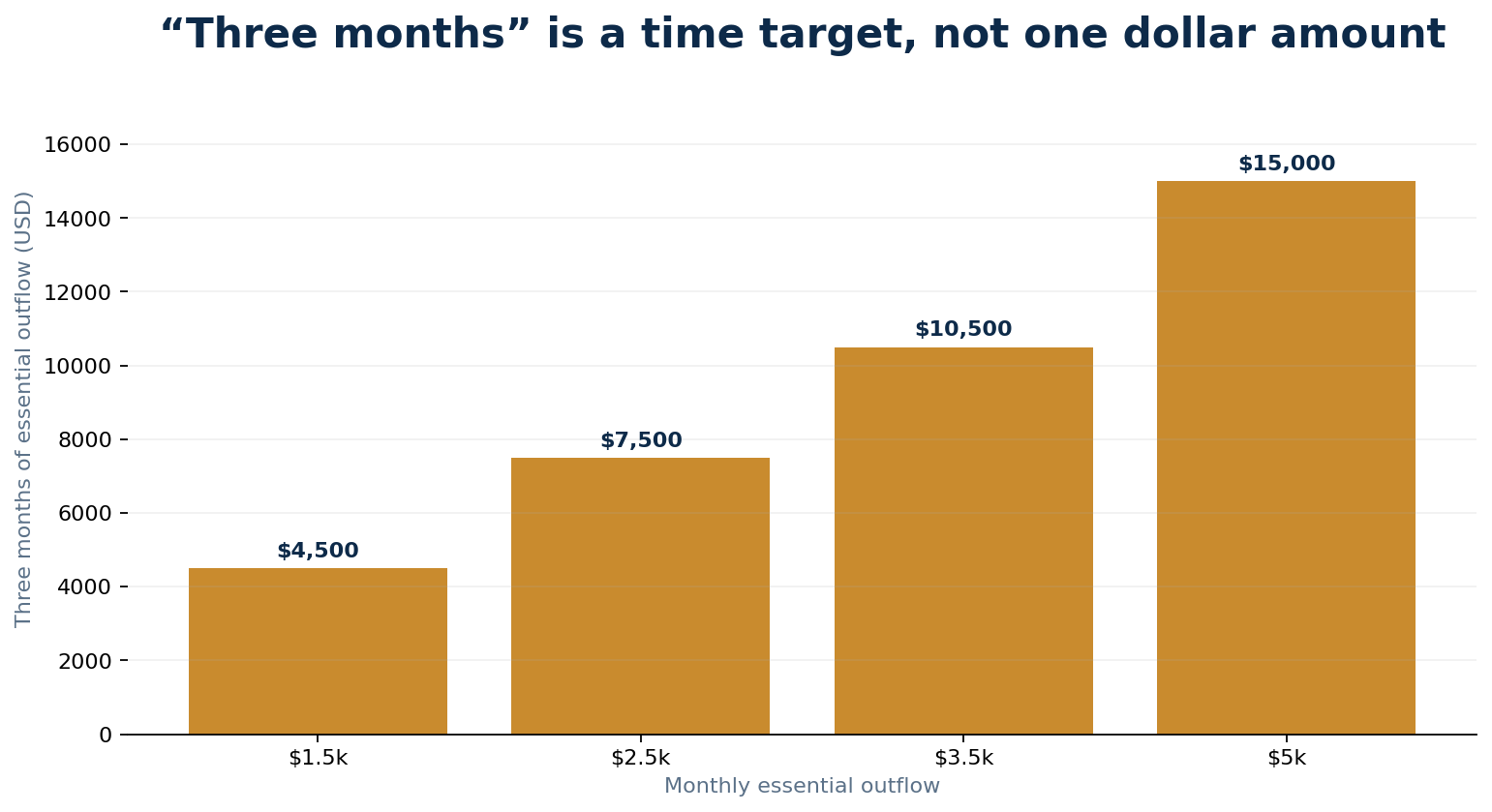
Illustrative income-loss scenario
Consider a neutral example with $6,000 of dependable monthly income, $4,800 of essential monthly outflow and $20,000 of accessible savings. The reserve behaves very differently depending on how much income remains.
| Income reduction | Income remaining | Monthly cash shortfall | $20,000 runway |
|---|---|---|---|
| 25% | $4,500 | $300 | 66.7 mo |
| 50% | $3,000 | $1,800 | 11.1 mo |
| 100% | $0 | $4,800 | 4.2 mo |
Use the evidence in your own plan
The Research report stays standardized. Use Carrowmont's planning tools and guides to work with your own expenses, debt minimums, savings target and cash-flow buffer.
Methodology and sources
Official SHED measures and Carrowmont calculations are kept separate. The Federal Reserve surveyed nearly 13,000 U.S. adults in October 2025 and published the 2025 household report in May 2026.
Citation and media note
For corrections, data questions or media/business enquiries, use the Carrowmont contact page.