Compare the dollar, official gold demand, real yields and stress without turning diversification into a collapse forecast.
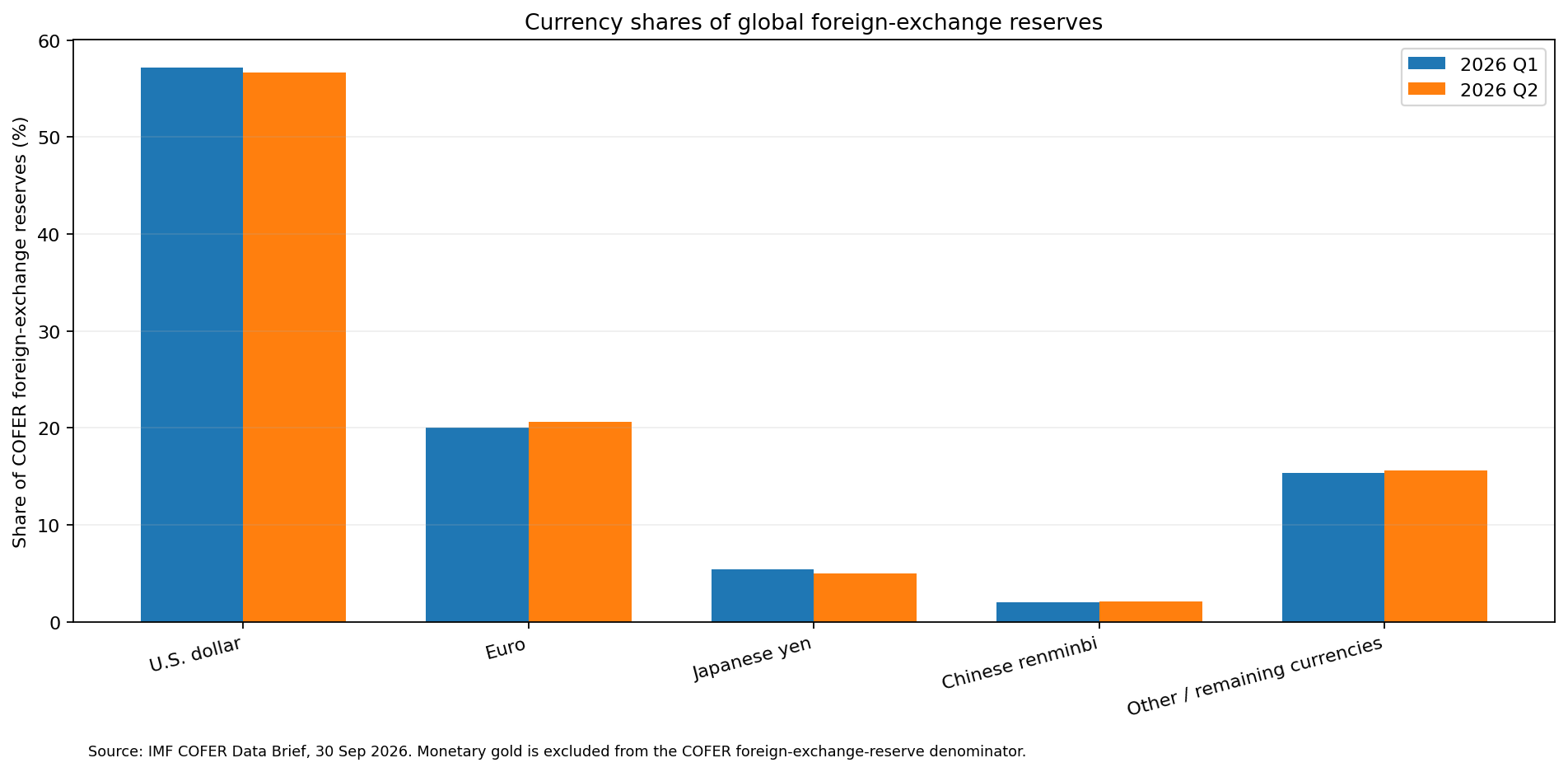
De-dollarisation means reducing reliance on the U.S. dollar in one or more functions—such as reserve holdings, trade settlement, borrowing or payments. The evidence supports gradual diversification, not a simple story that the dollar has already been replaced. IMF COFER still showed the dollar at 56.70% of global foreign-exchange reserves in Q2 2026, far ahead of any single alternative currency.
De-dollarisation can mean several different things
Headlines often use one word for several separate changes. A country can settle more trade in local currency while keeping most reserves in dollars. A central bank can buy gold without replacing dollars with another currency. A bank can issue more euro or renminbi financing while still using dollars for collateral or derivatives. These are all forms of diversification, but they are not economically identical.
| Dimension | What a shift would mean | What it would not prove by itself |
|---|---|---|
| FX reserve composition | Central banks hold a smaller share of foreign-currency reserves in dollars. | That gold or another single currency has replaced the dollar globally. |
| Gold holdings | Reserve managers increase a non-currency reserve asset. | That another fiat currency has taken over dollar functions. |
| Trade settlement | More bilateral or regional trade is invoiced or settled outside dollars. | That global funding, collateral and reserve markets have shifted equally. |
| Banking and securities | More loans, deposits or bonds use non-dollar currencies. | That the shift is broad enough to overturn network effects. |
| Payments infrastructure | Alternative clearing and settlement channels gain usage. | That users no longer need dollar liquidity in stress. |
What the latest IMF reserve data show
The IMF's Q2 2026 COFER data put total global foreign-exchange reserves at about US$13.22 trillion. The dollar share declined to 56.70% from 57.18% in Q1, while the euro rose to 20.60% from 20.04%. The renminbi increased to 2.11% and the yen fell to 4.96%.
Valuation effects can look like active de-dollarisation
Reserve shares are usually reported after converting holdings into U.S. dollars. If the euro appreciates, the dollar value of euro reserves can rise even if no one buys additional euro assets. Bond-price changes can also alter the reported value of reserve securities. The IMF highlighted this problem clearly in Q2 2025, when most of the apparent drop in the dollar share disappeared after adjusting for exchange-rate movements.
Q2 2026 was different: The IMF said exchange-rate movements were comparatively small, so valuation from FX moves explained less of the change. That does not mean every movement was active buying or selling; bond-price changes and other portfolio effects can still matter.
Gold diversification is not another currency replacing the dollar
Gold is a reserve asset, but it is not a currency in the COFER dataset and does not provide the same payment, funding or collateral ecosystem as major currencies. Central banks can increase gold because they want a non-sovereign reserve asset while continuing to hold large dollar portfolios for liquidity, intervention and financial-market access.
This is why the ECB's end-2025 comparison needs care. Gold's market-value share of total official reserves rose sharply as gold prices increased. Using an earlier gold price reduced the estimated gold share materially. The change was therefore partly valuation, not simply central banks swapping Treasury securities for bullion.
Trade settlement can diversify before reserve systems do
Countries can agree to settle some bilateral trade in local currencies for practical reasons: Reducing conversion costs, supporting regional integration or creating alternative payment channels. That can be meaningful without immediately changing the currency used for bank funding, derivatives, global collateral or reserve management.
IMF analysis using SWIFT data has noted that the U.S. dollar still accounts for more than 80% of trade finance globally, even while some regional blocs increase non-dollar usage. A true replacement story would need to extend well beyond a few trade corridors.
“The dollar reserve share fell, therefore countries sold dollars” is not automatically true. Exchange rates, bond prices, methodological changes and imputation can move reported shares. “Central banks bought gold, therefore another currency replaced the dollar” is also incorrect because gold is a different kind of reserve asset.
What evidence would support genuine dollar displacement?
A stronger displacement case would require persistent, broad changes across several functions at the same time:
- A large and durable decline in dollar reserve share after valuation adjustments;
- deep alternative safe-asset markets that can absorb reserve-scale flows;
- greater use of alternatives in cross-border bank funding and bond markets;
- greater use as derivatives collateral and a reliable source of crisis liquidity;
- broad trade-finance and payment adoption beyond a few bilateral arrangements;
- confidence in convertibility, legal access and capital mobility during stress.
Checklist: What would change the conclusion?
- Reserve data: Is the dollar decline persistent across several years rather than one quarter?
- Valuation adjustment: Does the decline remain after exchange-rate and bond-price effects?
- Alternative asset depth: Can another market absorb very large, liquid reserve portfolios?
- Private-sector use: Are banks, issuers and investors moving funding and collateral functions too?
- Trade finance: Is usage broad across regions rather than concentrated in specific corridors?
- Stress behavior: Do institutions seek the alternative currency when liquidity is scarce?
- Gold vs currency: Is the change actually a move into gold rather than a replacement fiat currency?
Key takeaway
The world is diversifying at the margin: Reserve managers hold more nontraditional currencies and more gold, and some trade is settling outside dollars. But the available evidence is more consistent with a more diversified dollar-centered system than with a completed handover to a new dominant reserve currency.
Frequently asked questions
Is de-dollarisation the same as dollar collapse?
No. A currency can lose some reserve or payment share gradually while remaining dominant in several financial functions.
Does the rise in central-bank gold prove countries sold Treasuries?
No. Gold can be funded from local purchases, other reserve assets, new reserve accumulation or portfolio changes. Gold's market-value share can also rise because its price rises.
Why does the COFER denominator matter?
COFER measures foreign-exchange reserves and excludes monetary gold. Total official reserves including gold use a broader denominator.
What is the U.S. spelling of de-dollarisation?
Common variants include de-dollarization and dedollarization. They describe the same broad process when used carefully.
Sources and how this guide was prepared
Current reserve figures are dated reference points, not forecasts. Sources were reviewed on 22 October 2026. The page deliberately distinguishes currency shares, gold holdings and financial-market functions.
- IMF Data Brief — COFER, Second Quarter 2026 — Latest reviewed Q2 reserve shares and the IMF's interpretation of valuation and portfolio effects.
- IMF — COFER Frequently Asked Questions — Defines the foreign-exchange-reserve denominator and confirms monetary gold is excluded.
- IMF — Dollar Dominance in the International Reserve System: An Update — Discusses gradual diversification into several nontraditional reserve currencies.
- IMF — Geopolitics, global trade and the dollar — Notes continuing dollar dominance in trade finance alongside regional diversification.
- ECB — The international role of the euro, June 2026 — Reviews reserve currencies, fragmentation and gold's changing role.