Place official-sector demand alongside real yields, the U.S. dollar, inflation and stress instead of treating one driver as a price forecast.
Central banks buy gold because it is a reserve asset that is not another government's or bank's liability. It can diversify foreign-currency reserves, provide crisis and geopolitical insurance, preserve value over long horizons and reduce dependence on assets held inside another jurisdiction. But gold has trade-offs: It pays no coupon, its price is volatile, physical holdings have storage and operational costs, and it is less useful than liquid government securities for everyday intervention and payments.
Why gold can be useful to a central bank
A central bank is not trying to maximize household-style investment returns. It manages national reserves so the country can meet foreign-currency obligations, support market confidence, intervene in currency markets when policy requires it and retain liquidity during stress. That makes the reserve problem broader than asking which asset has the highest expected return.
Gold is unusual because it has no issuing sovereign and no promise from a commercial bank. Physical gold held under the reserve manager's control can reduce exposure to another country's credit system or legal jurisdiction. That characteristic became more visible after major reserve-access sanctions in the post-2022 geopolitical environment, but it does not mean every gold purchase is a prediction of sanctions, default or dollar collapse.
What the demand data actually show
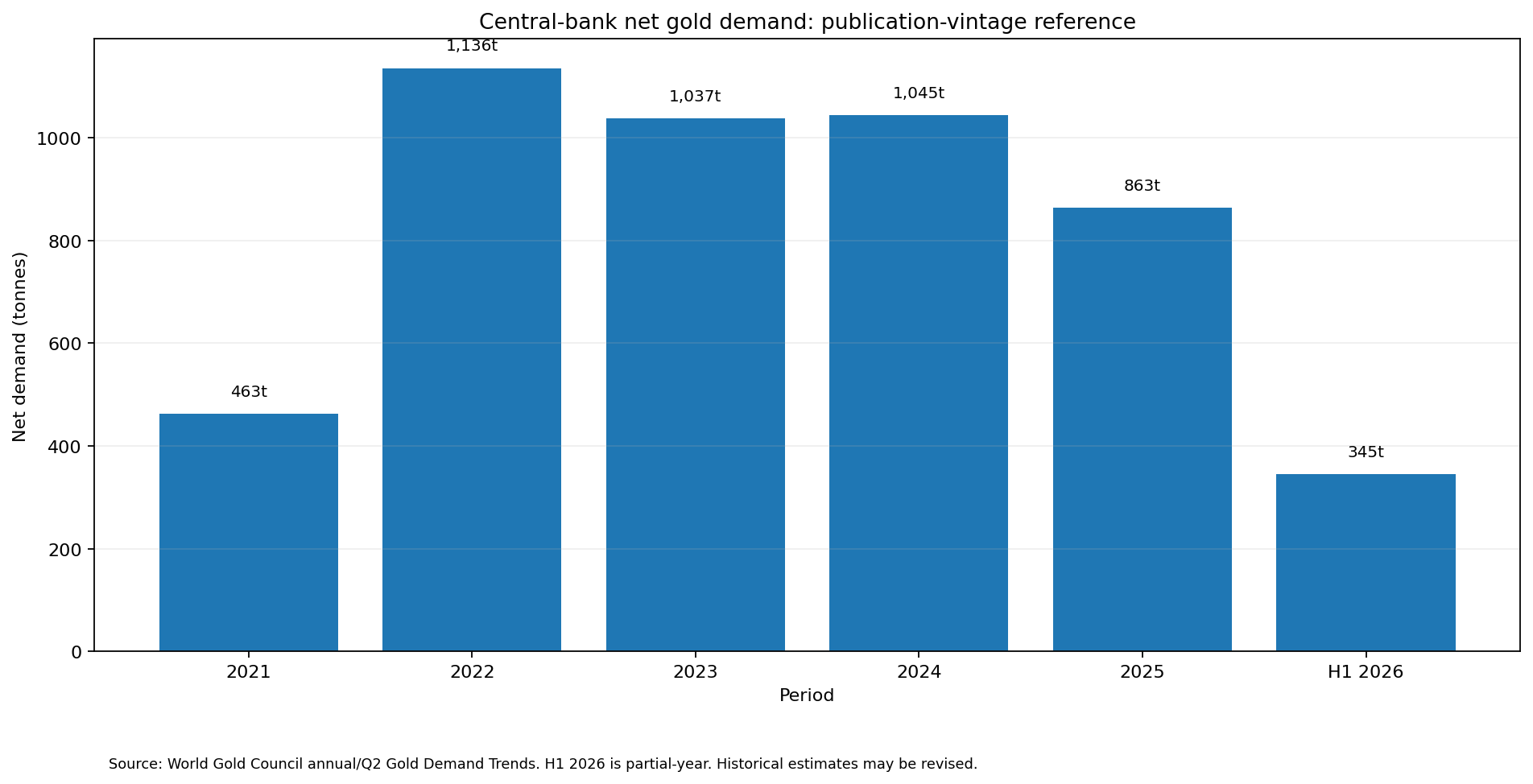
World Gold Council estimates show a clear change in the scale of official-sector demand after 2021. Annual net demand rose from about 463 tonnes in 2021 to roughly 1,136 tonnes in 2022, then remained around 1,000 tonnes in 2023 and 2024 before moderating to about 863 tonnes in 2025. For the first half of 2026, WGC estimated net demand at about 345 tonnes after a weak first quarter and a record second quarter.
| Period | Net demand | Publication-vintage note |
|---|---|---|
| 2021 | 463.1 t | WGC full-year 2021 estimate. |
| 2022 | 1,135.7 t | WGC full-year 2022 estimate; later vintages can revise earlier years. |
| 2023 | 1,037.4 t | WGC full-year 2023 estimate. |
| 2024 | 1,044.6 t | WGC full-year 2024 estimate; the 2025 report later restated 2024 at a higher figure. |
| 2025 | 863.3 t | WGC full-year 2025 estimate. |
| H1 2026 | 345 t | Partial-year estimate; Q2 contributed about 289 t. |
What reserve managers say they value about gold
The World Gold Council's 2026 Central Bank Gold Reserves Survey received 76 responses. It reported that 89% of respondents expected global central-bank gold reserves to increase over the following 12 months, while a record 45% expected their own institution's holdings to rise. The survey highlighted crisis performance, diversification, inflation protection, geopolitical-risk hedging and long-term store-of-value characteristics among the reasons for holding gold.
These are survey responses, not a promise of future purchases. Reserve managers can change plans as prices, liquidity needs, exchange rates and domestic conditions change.
Selected 2026 examples: Buyers and sellers can coexist
Official-sector activity is not one-way. WGC's Q2 2026 review highlighted continued accumulation from Poland and China, while Türkiye, Russia and Azerbaijan were important sellers during parts of the first half. Its October update reported another 39 tonnes of net buying in August, led by China with Uzbekistan and Poland also adding, while Russia and several others reported sales.
That mixed pattern matters. A central bank may buy gold for strategic diversification in one period and sell or mobilize it later for liquidity, currency defense, reserve management or other country-specific reasons. “Central banks are buying” is a global net statement, not evidence that every central bank is doing the same thing.
Gold can rise as a reserve share even without the same volume of buying
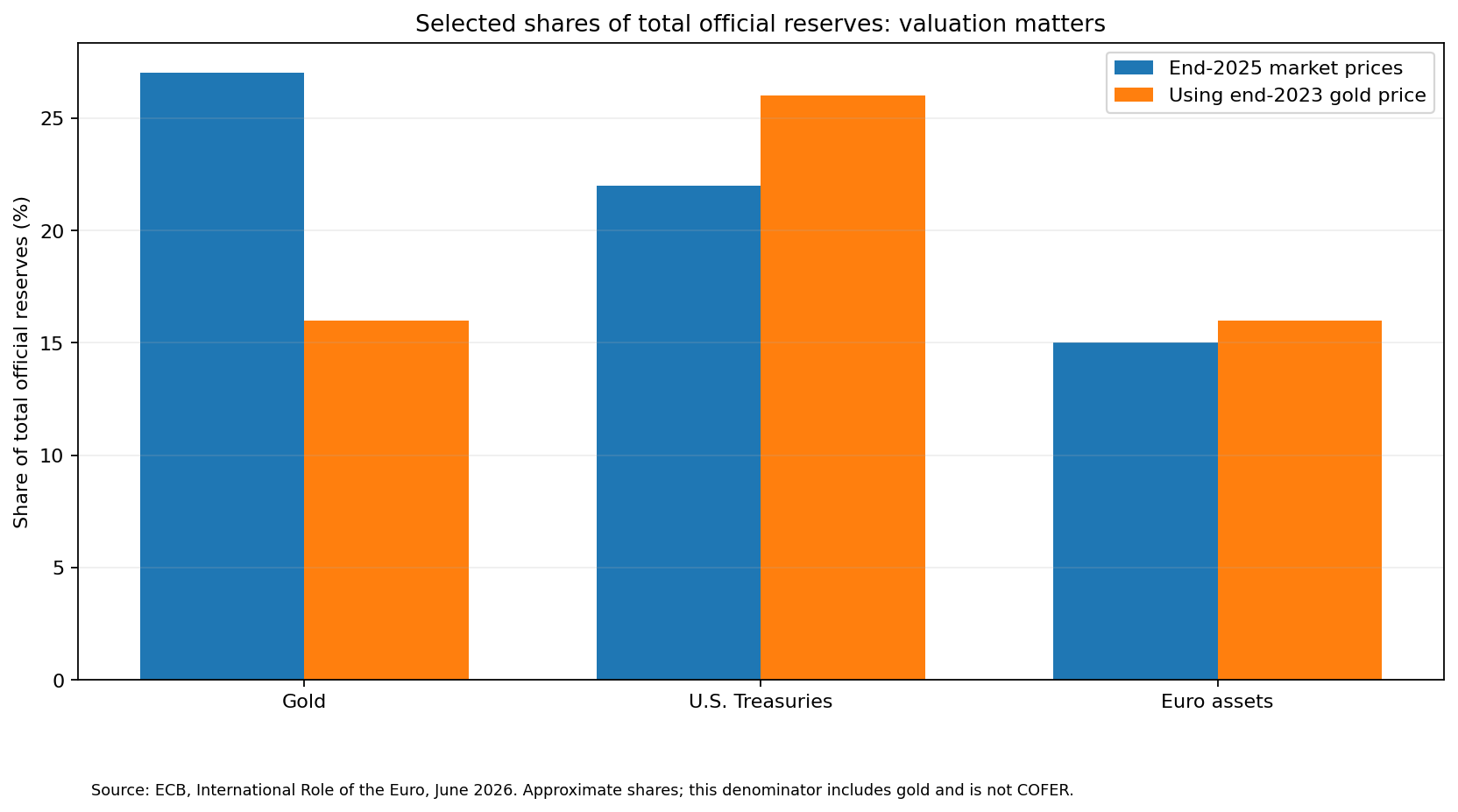
Reserve shares are measured at market value. When gold prices rise sharply, gold can become a larger percentage of reserves even if physical holdings change only modestly. The ECB estimated that at end-2025 market prices, gold represented about 27% of total official reserves in its comparison, versus about 22% for U.S. Treasuries and 15% for euro assets. When the ECB recalculated the comparison using the end-2023 gold price, gold's share fell to about 16%, while U.S. Treasuries were about 26%.
Gold's reserve advantages and limitations
| Potential reserve advantage | Important limitation |
|---|---|
| No issuing-government or bank liability | The market price can be volatile. |
| Can be held domestically or across diversified custody locations | Physical storage, transport, verification and security create operational costs. |
| Long history as a crisis and store-of-value asset | Gold pays no coupon or contractual interest. |
| Can diversify a portfolio concentrated in foreign currencies | It is less convenient than liquid foreign-currency securities for routine intervention and payments. |
| Can reduce some jurisdiction/access dependence | Liquidity and market access still matter, and gold does not remove all political or operational risk. |
“Central banks are buying gold, therefore the dollar is about to collapse” skips the evidence. Gold can rise alongside continued heavy use of dollars because the assets perform different reserve functions. Price changes can also lift gold's measured reserve share without equivalent physical purchases. The correct question is what reserve function is changing, not which dramatic narrative sounds most certain.
Checklist: How to read a central-bank gold headline
- Is the number reported or estimated? WGC aggregate demand includes estimates of activity not yet publicly disclosed.
- What is the data date? Monthly reserve reports arrive with lags and can be revised.
- Is it gross buying, net buying or a change in reported reserves? These are not always the same measure.
- Could valuation be driving the share? A higher gold price can lift gold's percentage of reserves.
- Is the country a buyer or seller for operational reasons? Domestic production, swaps, liquidity needs and currency management can matter.
- Which denominator is being used? COFER FX reserves exclude gold; total official reserves can include it.
- Is the headline turning diversification into a forecast? Reserve diversification is not proof of imminent sovereign default or currency collapse.
Central-bank objectives are not household objectives
A central bank manages sovereign liquidity, foreign-currency obligations, intervention capacity and resilience under geopolitical stress. A household normally needs emergency liquidity, long-term growth, income, retirement funding and protection against personal risks. The fact that a central bank holds or buys gold therefore does not imply any particular personal allocation to gold.
Key takeaway
The post-2021 rise in central-bank gold demand is real and historically important, but the best-supported explanation is reserve diversification and resilience, not a single forecast about the dollar or U.S. default. Gold has useful reserve properties precisely because it differs from government securities—and it also has limitations that prevent it from replacing liquid currency assets for many day-to-day reserve functions.
Frequently asked questions
Are all central banks buying gold?
No. Global net demand can be positive while individual central banks sell. Country-specific liquidity, domestic gold production, swaps, currency intervention and portfolio decisions can all affect reported activity.
Does central-bank gold buying mean the U.S. dollar is being abandoned?
No. Gold diversification and lower dollar reserve share are separate questions. The dollar can lose some share while remaining the dominant reserve and funding currency.
Does COFER include central-bank gold?
No. IMF COFER covers foreign-exchange reserves by currency and excludes monetary gold from that denominator.
Why would a central bank hold an asset with no yield?
Reserve portfolios balance several objectives, including liquidity, crisis resilience, diversification and access risk. Yield is important, but it is not the only objective.
Sources, data and methodology
Carrowmont reviewed these sources on 22 October 2026. WGC demand figures are industry estimates and can be revised as delayed or unreported official activity becomes known. The downloadable annual/H1 table deliberately preserves publication-vintage figures and labels H1 2026 as partial year.
- World Gold Council — Central Bank Gold Reserves Survey 2026 — Survey motivations and expectations from 76 reserve-manager respondents.
- World Gold Council — Gold Demand Trends Q2 2026: Central Banks — H1/Q2 demand estimates and revision note.
- World Gold Council — Central-bank gold statistics, August 2026 — Latest reviewed monthly reported activity through August where available.
- ECB — The international role of the euro, June 2026 — Reserve composition, gold valuation effects and limitations of gold as a reserve asset.
- IMF — COFER Frequently Asked Questions — Confirms monetary gold is excluded from COFER foreign-exchange reserves.