See how real yields, the U.S. dollar, official demand and stress can pull gold in different directions without declaring one reserve asset universally superior.
Gold and high-quality government securities can be complements in an official reserve portfolio because they solve different problems. Government securities can provide yield, deep market liquidity, collateral and direct foreign-currency purchasing power. Gold has no issuing government's liability and can diversify some inflation, geopolitical and jurisdiction risks. Neither is universally “safer” in every scenario.
Gold and government bonds solve different reserve problems
A central bank needs reserves for more than one purpose. It may need immediately usable foreign currency, assets that can be sold or pledged in large markets, income, crisis insurance and diversification from concentrated exposures. That is why official reserve portfolios commonly contain more than one type of asset.
| Reserve characteristic | Physical gold | High-quality government securities |
|---|---|---|
| Issuer/default liability | No issuing sovereign liability. | Depends on the issuing government and legal terms. |
| Yield/income | No coupon; return comes from price changes. | Usually pays interest or is issued at a discount. |
| Market liquidity | Large global market, but converting physical holdings can involve custody/settlement steps. | Major sovereign markets can provide very deep same-currency liquidity. |
| Duration sensitivity | No bond duration, but gold price can be volatile. | Longer-maturity securities can fall sharply when yields rise; short bills behave differently. |
| Inflation sensitivity | Can act as long-horizon inflation/tail-risk insurance, but is not a reliable short-term CPI tracker. | Nominal bonds can lose real value with inflation; inflation-linked bonds are different. |
| Collateral/payment utility | Useful in some secured markets but less convenient for routine currency intervention. | Major sovereign securities are widely used as collateral and can provide direct currency liquidity. |
| Custody/jurisdiction | Physical gold can be stored domestically or diversified across vaults. | Access depends on legal, custody, settlement and jurisdiction arrangements. |
| Operational friction | Storage, transport, verification and insurance matter. | Electronic settlement is usually simpler, though market infrastructure and sanctions/access risk still matter. |
“Government bonds” is not one uniform asset
A three-month Treasury bill, a 10-year note and a 30-year bond are obligations of the same U.S. sovereign issuer, but they do not have the same price sensitivity or reinvestment risk. The same principle applies across countries: Credit quality, currency risk, market depth, capital controls, legal confidence and inflation exposure can differ materially.
This is why a reserve manager can remain comfortable holding short-dated dollar securities for operational liquidity while also wanting more gold for long-horizon diversification. The choice is not simply “trust Treasuries” versus “buy gold.”
What the end-2025 reserve-composition comparison teaches
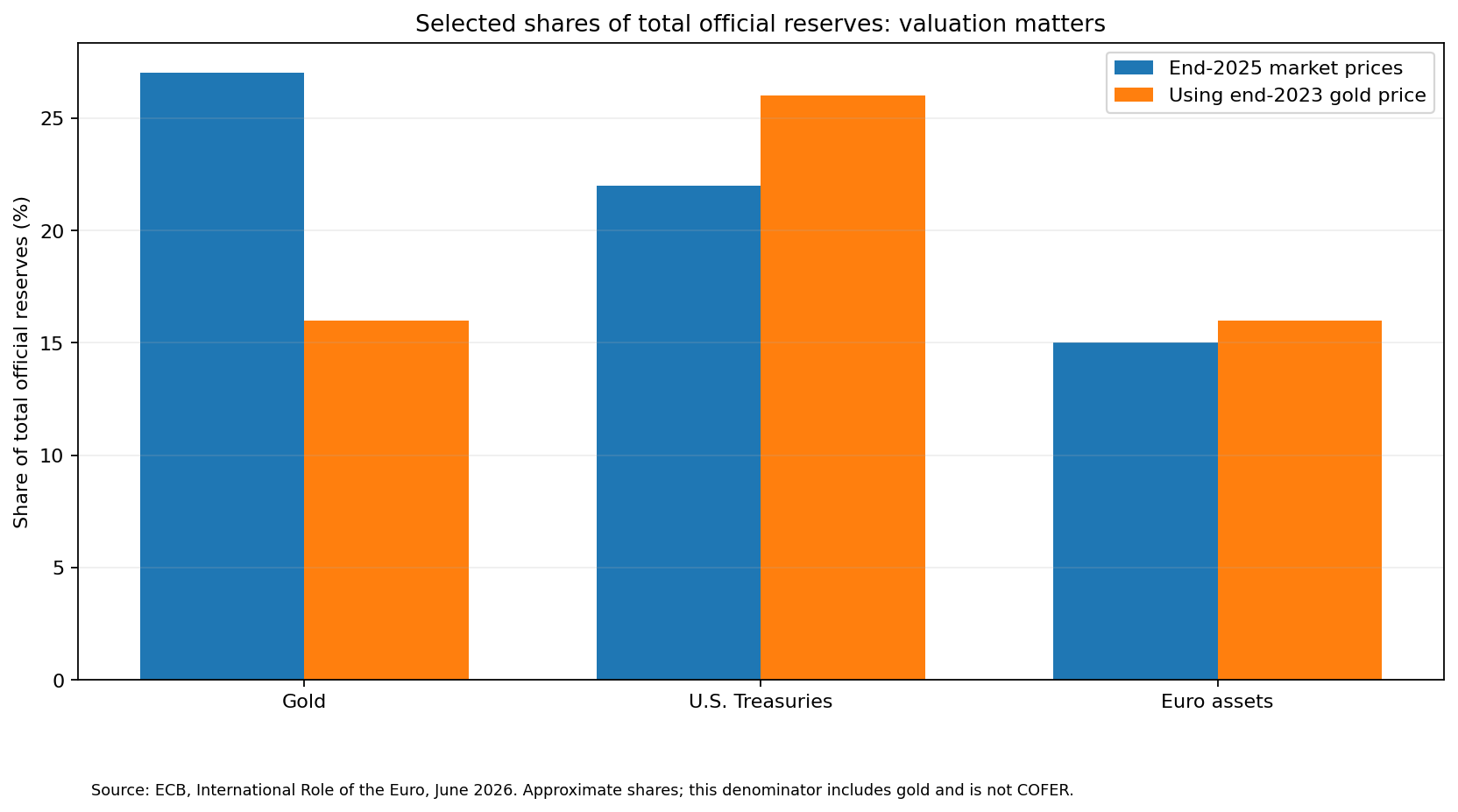
The ECB estimated that gold represented about 27% of total official reserves in its end-2025 market-value comparison, versus about 22% for U.S. Treasuries and 15% for euro assets. But much of the gold share reflected the large rise in gold's price. Recalculating with the end-2023 gold price reduced gold to about 16% and lifted the relative U.S.-Treasury share to about 26%.
What government securities do especially well
Major sovereign securities can be operational reserve workhorses. They can earn contractual income, settle electronically, serve as high-quality collateral and provide direct liquidity in the currency a central bank may need for intervention or external payments. Very large markets also allow reserve managers to transact in size.
But marketable government securities still carry risks. Long-duration bonds can lose market value when yields rise. Nominal fixed payments can lose purchasing power under inflation. Different sovereigns have different fiscal, currency, legal and institutional risks. And foreign-held assets can involve custody or access considerations that do not exist in the same way for domestically stored physical gold.
What gold does especially well
Gold's defining reserve feature is that it is not someone else's credit promise. That can make it attractive as long-horizon insurance against extreme inflation, geopolitical fragmentation, sanctions/access concerns or confidence shocks. It can also diversify portfolios concentrated in one or two reserve currencies.
Gold's limitations are just as important. It produces no coupon, can be very volatile, requires secure storage and is not as convenient as a liquid foreign-currency security for routine intervention. Its supply also cannot expand quickly to meet a sudden global demand for transactional liquidity.
“Gold is safer than bonds” is too broad. Gold can fall sharply in market value. Long-duration nominal bonds can also fall sharply when yields rise. Short bills may behave very differently from long bonds, and sovereign risks differ by issuer. Reserve safety depends on the specific risk being insured: Liquidity, inflation, duration, credit, currency, custody or geopolitical access.
Illustration: One reserve portfolio, two different jobs
Imagine a central bank that needs assets for two purposes. First, it may need to intervene in the foreign-exchange market on short notice. Highly liquid short-dated securities in the relevant currency can be operationally useful. Second, it may want an asset that does not depend on the credit promise or payment system of another sovereign. Physical gold can serve that diversification role.
The point is not that one asset should be assigned a specific percentage. The point is that the two jobs are different, so holding both assets can be rational even when their short-term returns move in opposite directions.
Checklist: Before comparing gold with government bonds
- Which bond? Bill, note, long bond and inflation-linked security have different risks.
- Which government and currency? Credit quality, convertibility and market depth differ.
- Which reserve job? Intervention liquidity, income, collateral or tail-risk insurance?
- Which horizon? Short-term liquidity needs and multi-decade diversification are not the same problem.
- Is market value driving the comparison? Gold-price or bond-price changes can alter reserve shares.
- Where is the asset held? Custody and jurisdiction can matter under geopolitical stress.
- Are you applying a central-bank conclusion to a household? The objectives are fundamentally different.
Central-bank choices do not create a household allocation rule
A household normally needs productive growth assets, emergency liquidity and income to meet personal goals. A central bank needs sovereign liquidity, intervention capacity and national reserve resilience. Therefore, evidence that official reserve managers hold both gold and government bonds cannot be converted into a personal portfolio percentage without an entirely different analysis.
Key takeaway
Gold and high-quality government securities are not perfect substitutes. Bonds can provide yield, liquidity, collateral and direct currency utility; gold can provide a non-sovereign reserve asset with different crisis and access characteristics. A resilient reserve system can use both precisely because their strengths and weaknesses are different.
Frequently asked questions
Why would a central bank hold Treasuries if it is worried about U.S. fiscal risk?
Short-dated Treasury securities can still provide deep dollar liquidity and limited duration risk. Concern about long-run fiscal dynamics does not make every maturity or use case identical.
Does gold have no risk because it has no issuer?
No. Gold avoids issuer-default liability, but its market price can be volatile and physical ownership has storage, security and operational risks.
Are all government bonds equally liquid?
No. Market depth, trading infrastructure, currency convertibility and investor participation differ substantially across sovereign markets.
Does the ECB comparison mean gold replaced Treasuries?
No. The ECB explicitly showed that much of gold's higher end-2025 reserve share reflected valuation from the gold-price increase.
Sources and how this guide was prepared
Sources were reviewed on 22 October 2026. The reserve-share chart uses ECB staff estimates and keeps the broader total-reserve denominator separate from IMF COFER.
- ECB — The international role of the euro, June 2026 — Gold, U.S. Treasury and euro-asset reserve shares, valuation effects and gold's reserve limitations.
- IMF — COFER Frequently Asked Questions — Defines foreign-exchange reserves and confirms gold is outside the COFER denominator.
- World Gold Council — Central Bank Gold Reserves Survey 2026 — Reserve-manager motivations and operational/custody considerations.
- U.S. Treasury FiscalData — Federal borrowing — Background on Treasury securities and government financing.